The Consistency Equation: Why Most People Quit at Week 6
The Consistency Equation: Why Most People Quit at Week 6
There's a remarkably consistent pattern in fitness quitting.
It almost never happens in week 1, 2, or 3. Those are easy. New, novel, exciting.
It almost never happens in month 6, 12, or 24. By then the habit is real.
It happens somewhere between week 4 and week 8. Most often, week 6.
If you can see this pattern coming and beat it, you're on the right side of the long-term odds. Here's why it happens and how to get through it.
The pattern
Weeks 1 to 3: high motivation, fast progress, novelty.
Weeks 4 to 6: motivation fades. Progress slows. The shine wears off.
Week 6 (give or take): the gap between "this is exciting" and "this is just life now" closes. If you don't have the identity and the system built yet, you quit.
Weeks 7 onward: the people who didn't quit at week 6 are now on rails. Showing up is the default.
Whether the gym membership lasts 6 weeks or 6 years is mostly decided by what you do between weeks 4 and 8.
Why week 6 is the quit zone
Three things converge.
Beginner gains have slowed. The first 4 weeks of any new program produce visible newbie progress. Strength jumps fast. The mirror looks slightly better. Then around week 4 to 6, progress slows to normal lifter pace, which is much slower. You expected continued fast progress. Reality delivered grinding moderate progress. The mismatch demoralizes you.
Motivation has decayed. The neurochemistry of "starting something new" is dopamine-rich. The first few sessions feel exciting. By week 5 or 6, that's gone. You're left with the actual work, which is less exciting.
The first major fatigue has accumulated. If you've been training 3 to 5 times a week for 6 weeks without a deload, you're carrying real fatigue. Sleep gets weird. Sessions feel harder. You're due for the planned deload, but the deload looks like "less work," which feels like "I'm getting weaker."
These three things land in the same week. The convergence is what kills programs.
What's actually happening (and why it's not failure)
Three things you should know to reframe the week 6 dip.
Your progress hasn't actually stalled. It's just slowed to normal. The first 4 weeks were not the new baseline. The first 4 weeks were the calibration phase. Months 2 through 24 will be slower. This is correct. This is what real progress looks like.
The fatigue is supposed to be there. Your program was designed to build up training stimulus across 4 to 6 weeks, then deload, then build again. The fatigue at week 6 is the trigger for the deload that will produce week 8's PRs.
The "I'm not seeing results" feeling is partly identity, not body. You're now in the middle ground between "starting" and "established." You're not new anymore but you're not transformed yet. This middle ground is the most psychologically uncomfortable place in any change journey.
The work hasn't failed. You're just inside the part that everyone hates.
How to beat week 6 specifically
Five things, in order of importance.
One: deload, on schedule
If you've been progressively training for 4 to 6 weeks, the next week should be a deload regardless of how you feel. The engine in this app schedules it automatically. Run it. Don't skip it.
A deload is what takes week 6's fatigue and turns it into week 8's PRs. Skipping the deload because "I'm finally getting the hang of this" guarantees you'll feel worse in week 7 than week 6.
Two: zoom out the metric you're judging by
If you're evaluating progress weekly, you're going to feel terrible in week 6. Weekly progress is noisy and small at best.
Zoom out. Compare your week 6 lifts to your week 1 lifts. Compare your week 6 photos to your week 1 photos. Compare your work capacity now to a month ago.
The trend across 6 weeks looks great. The trend across last week to this week looks flat. Which metric you anchor on determines whether you quit.
Three: lock the schedule, not the outcome
You don't control how fast you progress. You control whether you show up.
Stop evaluating your week by "did I make progress." Start evaluating by "did I do my scheduled sessions and check-ins."
If you trained your 4 sessions and did your check-ins, the week was successful. The PRs are a downstream output, not a daily judgment.
Four: use the proactive coach
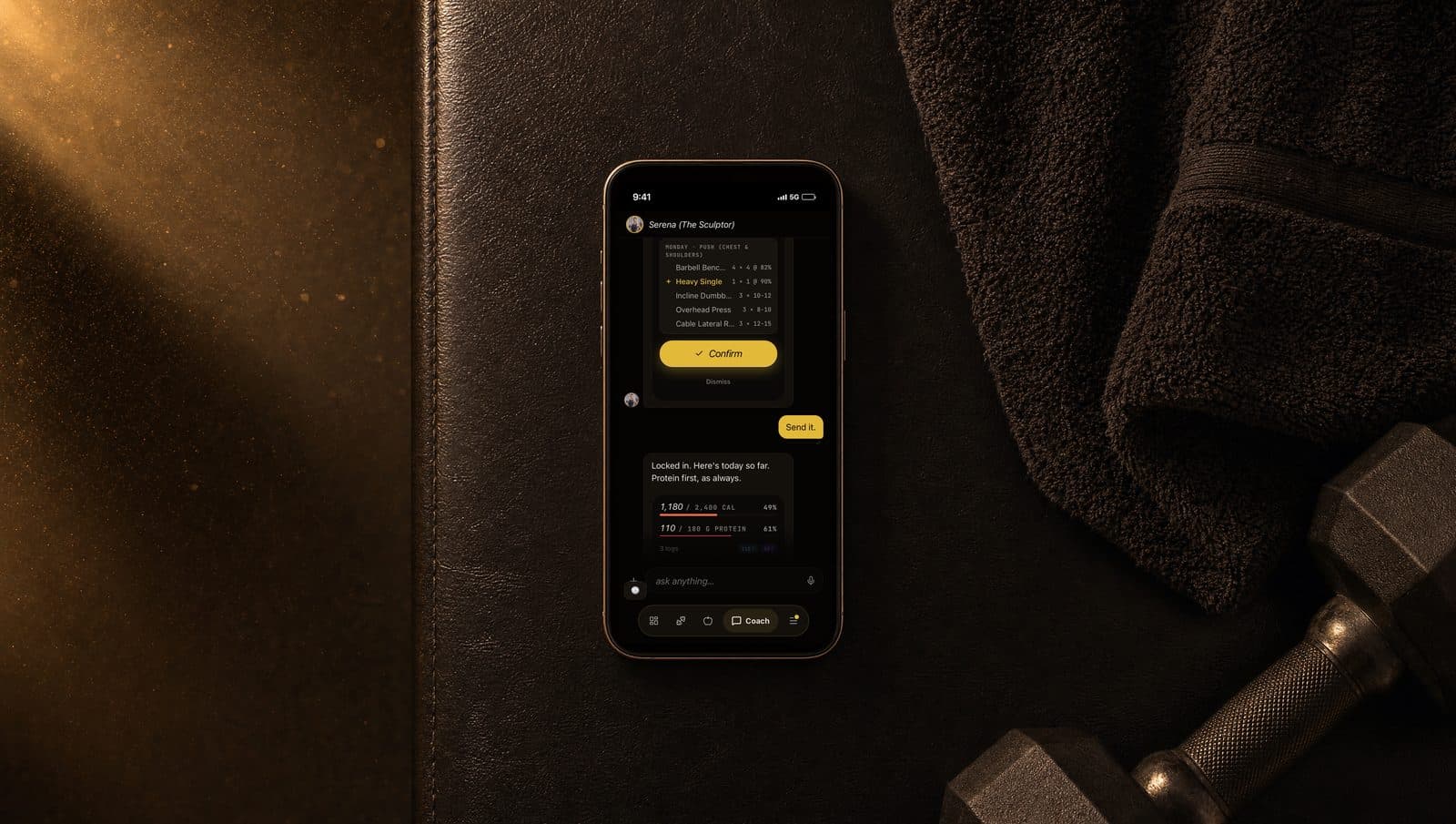
The coach has a churn-risk trigger that fires when your activity drops or your engagement slips. If you've been quieter than usual or skipping sessions, expect a coach message during week 5 or 6.
Read it. Respond to it. Even if you're not in a good place, telling the coach "I'm struggling, can we make this week easier" produces a real adjustment. Don't ghost. The conversation with the coach is one of the highest-leverage things you can do during a low motivation period.
(Coach Chat requires Standard or Concierge tier.)
Five: have an "if I quit" thought experiment ready
When you feel the urge to skip the next session or stop the program entirely, run this thought:
"If I quit this program now, what's my alternative? Where will I be in 6 months if I don't do this?"
The answer is almost never "I'll do another program that's better." The answer is "I'll do nothing, like the last several times I quit. Six months from now I'll be in the same place I started, having lost the 6 weeks I already invested."
Quitting is not "starting fresh." Quitting is undoing 6 weeks of work and being back at week 0 with worse momentum than the first time.

What the data says about getting through the dip
People who make it past week 8 of a structured program have a roughly 70% chance of still training a year later.
People who quit before week 8 have a roughly 5% chance of being on a different program a year later that they stuck with.
Translation: quitting in the dip doesn't lead to "finding a better program." It leads to not training for the next year and ending up here again.
The dip is the entry fee for the long game.
Common mistakes during the week 6 zone
Starting a new program because "this one isn't working." This one is working. You're inside the part that everyone hates. Switching programs resets the clock and you'll be in the same place in another 6 weeks with a different program.
Doubling down with more volume. "I'm not progressing, I need to add 2 days a week and 3 more exercises per session." This is how you turn a 6-week stall into a 12-week injury. Less is more during fatigue.
Skipping the scheduled deload. The deload feels like a setback. It's the opposite. Skipping it guarantees the setback you're trying to avoid.
Comparing to someone 12 months ahead of you. You're 6 weeks in. They're 18 months in. Of course they look different. Compare to your week 0 self.
Trying to do everything at once. Lifting + cutting + cardio + tracking + sleeping perfectly + supplements + mobility work. Pick the 2 or 3 things that matter most for your goal. Drop the rest until the basics are automatic.
What to do this week if you're in the dip
If you're somewhere between weeks 4 and 8 and feeling shaky, do these in order:
- Check your schedule. Is a deload coming up? If yes, run it. Don't skip.
- Open the Stats tab. Look at your trend across the full 6 weeks, not just this week.
- Message the coach. Tell it you're struggling. Ask if anything in your program should change. Get a real response.
- Make the next session non-negotiable. Schedule it. Pack the bag. Show up. Even if it's terrible, show up.
- Read this article again in 3 weeks. By week 9 you'll feel different. You won't believe you almost quit.
What to do next
If you're not in the dip yet, save this article. You'll need it in 4 to 8 weeks.
If you're in the dip right now, remember: this is the universal pattern. Everyone hits it. The people who beat it are now in the gym every week of their lives. The people who don't are reading this article again in 6 months from week 1.
Get past week 8. The rest is downstream.