Reading Your Stats Tab Like a Coach Reads a Whiteboard
Reading Your Stats Tab Like a Coach Reads a Whiteboard
The Stats tab has more useful information than 90% of users notice.
Most people glance at it once a week, see "looks fine," and close it. They miss the signals that would let them adjust before a plateau, an injury, or a motivation crash.
A good coach scans a whiteboard of numbers and spots three things in 60 seconds: what's trending right, what's trending wrong, and what's about to break.
You can do the same with your Stats tab. Here's how.
The 5-minute weekly read
Once a week (Sunday or Monday works well), open the Stats tab and run through these five reads in order.
Read one: workout completion
How many of last week's planned sessions did you actually complete?
4 out of 4 (or whatever your week was): the plan is matched to your reality. Continue.
3 out of 4: acceptable. The system is robust to one missed session.
2 out of 4 or fewer: flag this. Either the plan is too aggressive for your life, or something's interfering with adherence. Time to either reduce planned frequency or fix the friction.
If you're consistently completing only half your planned sessions, the plan is wrong. Reduce frequency to a level you actually hit. Three completed sessions a week beats five planned sessions you only do two of.
Read two: average RPE trend
In the Training subtab, find your weekly RPE average.
Stable around your target (usually 7 to 8): healthy. Programming is matched to your recovery.
Trending up week over week: fatigue accumulating. You're due for a deload (which the engine probably already scheduled).
Trending down at constant weights: you're getting stronger faster than the engine is updating. Volume might be slightly low, or your weights could increase faster. Either let the engine catch up (it will within a week) or tell the coach.
Average over 8.5+: you're grinding too hard. Either reduce intensity for a week or expect a deload soon.
The RPE trend is the single most useful number in the Stats tab. It tells you the relationship between stimulus and recovery faster than any other metric.

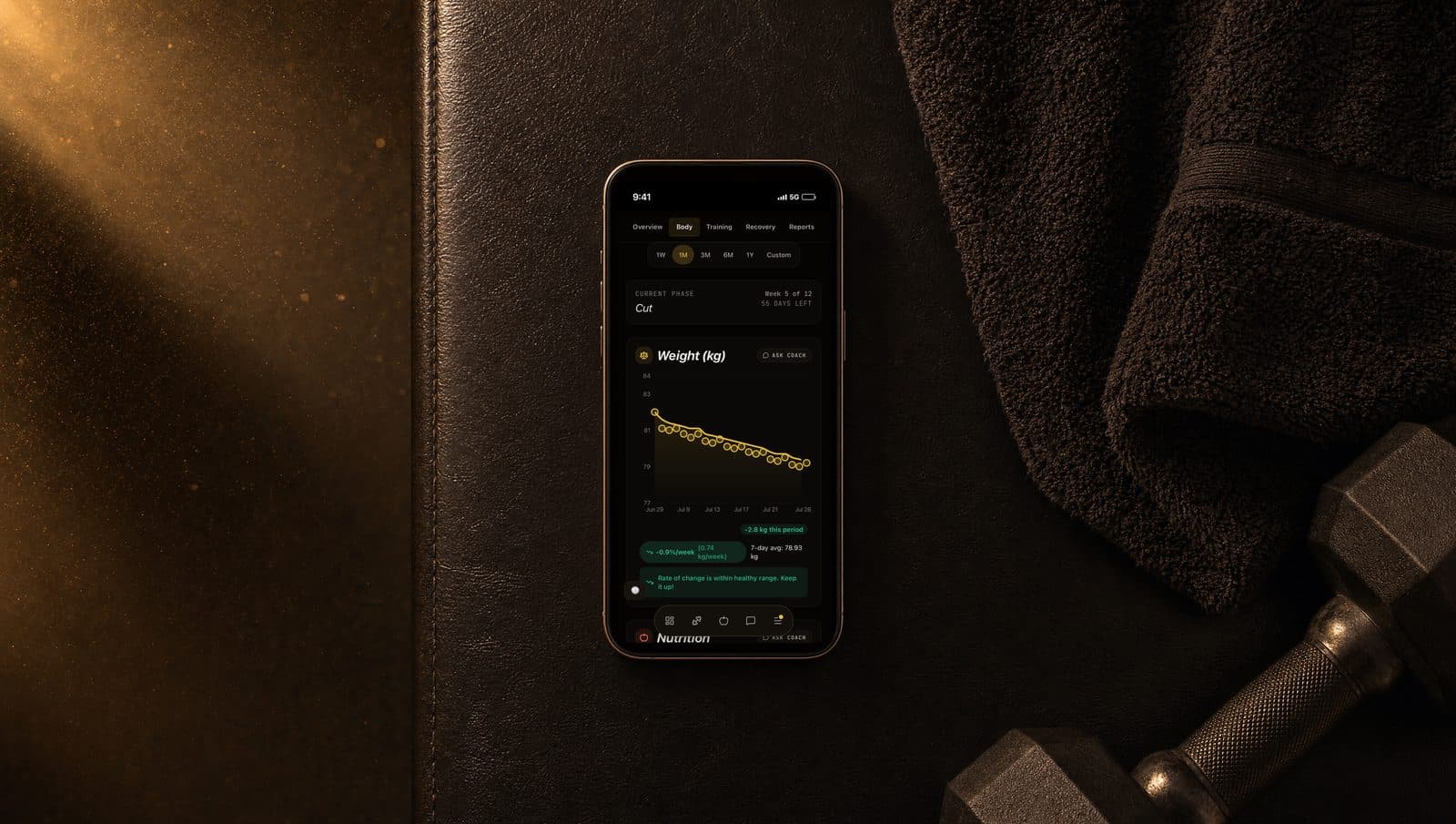
Read three: bodyweight trend
In the Body & Nutrition subtab, find your 7-day moving average bodyweight.
Moving in the direction of your goal at the right rate: working. Continue.
Moving in the wrong direction: your calories don't match your goal. Adjust.
Flat for 3+ weeks while you're trying to change: you're at maintenance, not in a surplus or deficit. The number you think you're eating is wrong. Track more accurately.
Moving in the right direction too fast: you're losing too quickly (and probably losing muscle) or gaining too quickly (and probably gaining excessive fat). Pull back the deficit or surplus.
Target rates:
- Cutting: 0.5 to 1 lb per week of loss
- Bulking: 0.5 to 1 lb per week of gain
- Recomp: roughly flat with body composition changes visible in photos
Daily bodyweight bounces 2 to 5 pounds. Ignore daily numbers. Watch the 7-day average.
Read four: macro adherence
Same subtab. How close did you actually hit your macro targets last week?
85%+ adherence on calories and protein: dialed in. Continue.
70 to 85% adherence: acceptable but improvable. Pick one weekday meal that consistently goes off-target and fix it.
Below 70% adherence: your meal plan is fighting your life. Either change the meals (open Meal Plan tab, swap the ones you skip) or change your targets (loosen if they're unrealistic).
A 100% adherent person and a 70% adherent person aren't equal. The 70% person can get to 85% with one or two structural changes. The 100% person is impossible to improve.
Protein adherence is the most important single nutrition number. If your protein is 75%, fix that before worrying about anything else.
Read five: exercise history on your big lifts
In the Training subtab, look at the exercise history for your main compound lifts: squat, bench, deadlift, OHP, row.
Estimated 1RM trending up over 4 weeks: the program is working. You're getting stronger.
Estimated 1RM flat for 4+ weeks: plateau. Run the Why You Stopped Progressing diagnostic.
Estimated 1RM trending down for 2+ weeks: something is wrong. Either you're significantly under-recovered, under-eating, or genuinely overreached. Talk to the coach.
Pick 2 to 3 movements that matter most to you and watch their trend. Don't try to evaluate every exercise. The compounds carry the signal.
What to ignore (most of the time)
The Stats tab has more metrics than you need to read weekly. Some of them are interesting and not actionable.
Total volume per week is interesting context but rarely actionable unless it's wildly different from your normal baseline. The volume landmarks (MEV/MAV/MRV) compliance check is more useful than raw total.
Calorie burn estimates from your wearable are approximate at best. Use them as context, not gospel. If your wearable says you burned 800 calories on a workout and you cut your eating by 800 calories, you'll under-recover.
HRV is useful for hardcore recovery monitoring but most lifters don't need to look at it weekly. Trust the daily fatigue guardrail to do its work.
Step count matters mostly during a fat loss phase. Otherwise it's just informational.
When to do deeper dives
The 5-minute weekly read catches most issues. For specific situations, dig deeper.
You're stalled and want to know why. Use the plateau diagnostic article or ask the coach to do a full review of the last 4 weeks.
You're not seeing visible body changes despite "doing everything right." Photos every 2 weeks, body measurements (waist, hip, arm, thigh) every 4 weeks. Don't trust the scale alone for body composition changes.
You're considering changing the program. Look at the Reports subtab for the weekly auto-generated report. The coach evaluates your data and recommends specific changes. Read it before requesting a manual change.
Something feels wrong but you can't articulate it. Tell the coach in chat. "I feel like my training isn't going well but I'm not sure why." The coach pulls multiple data sources and can spot patterns you might miss.
How a coach reads your dashboard
When the coach runs your weekly adjustment, it checks:
- Workout completion rate.
- Average RPE trend over the last 3 weeks.
- Volume per muscle group compared to MEV/MAV/MRV.
- Bodyweight trend (7-day moving average) against your stated goal.
- Macro adherence percentage.
- Sleep average and consistency.
- Any chat feedback you've given that affects training.
You can run essentially the same scan in 5 minutes. The coach is faster and more thorough, but you reading your own data weekly is how you stay engaged with what's actually happening.
What to do this Sunday
Open the Stats tab. Run the 5-minute scan above:
- Workout completion (Overview).
- Average RPE trend (Training).
- Bodyweight 7-day average (Body & Nutrition).
- Macro adherence (Body & Nutrition).
- Big lift trends (Training).
If everything is green, do nothing. Continue.
If one thing is yellow or red, talk to the coach about it. Don't try to fix three things at once. One adjustment per week. Watch the data again next Sunday.