How the App Keeps You Out of the Injury Hole
How the App Keeps You Out of the Injury Hole
Most fitness apps will happily let you injure yourself.
They assign the same loaded barbell squat to a 24-year-old powerlifter and a 62-year-old with a cranky lower back. They ramp volume regardless of how poorly you slept last week. They cheer you on while you grind your sixth set at RPE 10 because nobody is watching.
This app watches.
Every workout your coach builds passes through a safety system you don't see. It is not a disclaimer. It is engineering. Here is what it actually does.
Safety is in the prompt, not the popup
The most common mistake fitness apps make is to put safety in the wrong place.
They put it in popups. "Are you sure?" "Consult your doctor." "By tapping continue you agree." Users dismiss those in less than a second and move on.
Real safety lives in the program before the program ever reaches your screen. Three layers protect you, and you never have to remember any of them.
Before generation. Your onboarding answers (age, injury flags, training age, equipment) filter the exercise pool. Contraindicated movements are removed from the catalog the engine can pick from. The engine cannot accidentally suggest something it never saw.
During generation. Safety directives are injected into the AI prompt as hard rules. RPE caps. Volume ceilings. Mandatory rest periods. The model cannot exceed them because they're framed as non-negotiable inputs, not suggestions.
After every workout. Your RPE, sleep, soreness, and strength trends feed back into the engine. If recovery signals deteriorate across the week, next week's volume drops automatically. You don't have to ask. The system asks for you.

Your injury flags are doing real work
When you flagged "lower back" or "shoulder" in onboarding, you weren't filling out a form. You were rewriting the exercise pool.
Each flagged joint removes a specific list of exercises from your program. Lower back pulls deadlifts, heavy bent rows, and good mornings. Shoulder pulls overhead pressing, behind-the-neck movements, and certain bench variations. Knee pulls deep squats and high-impact plyometrics. The replacements are not random. They're matched movements that train the same muscles through a safer path.
This is why your program looks different from your training partner's even if you both picked "muscle gain" and have the same training age. Their pristine joints get every barbell variation. Your cranky shoulder gets the landmine press and the incline machine instead.
If an injury heals, update your profile and the substitutions reverse. The exercises that were locked out come back into rotation within minutes.
RPE is the steering wheel
Rate of Perceived Exertion is the most important number you log. It's a 1-to-10 scale of how hard a set felt: 6 is conversational, 8 is two reps short of failure, 10 is failure.
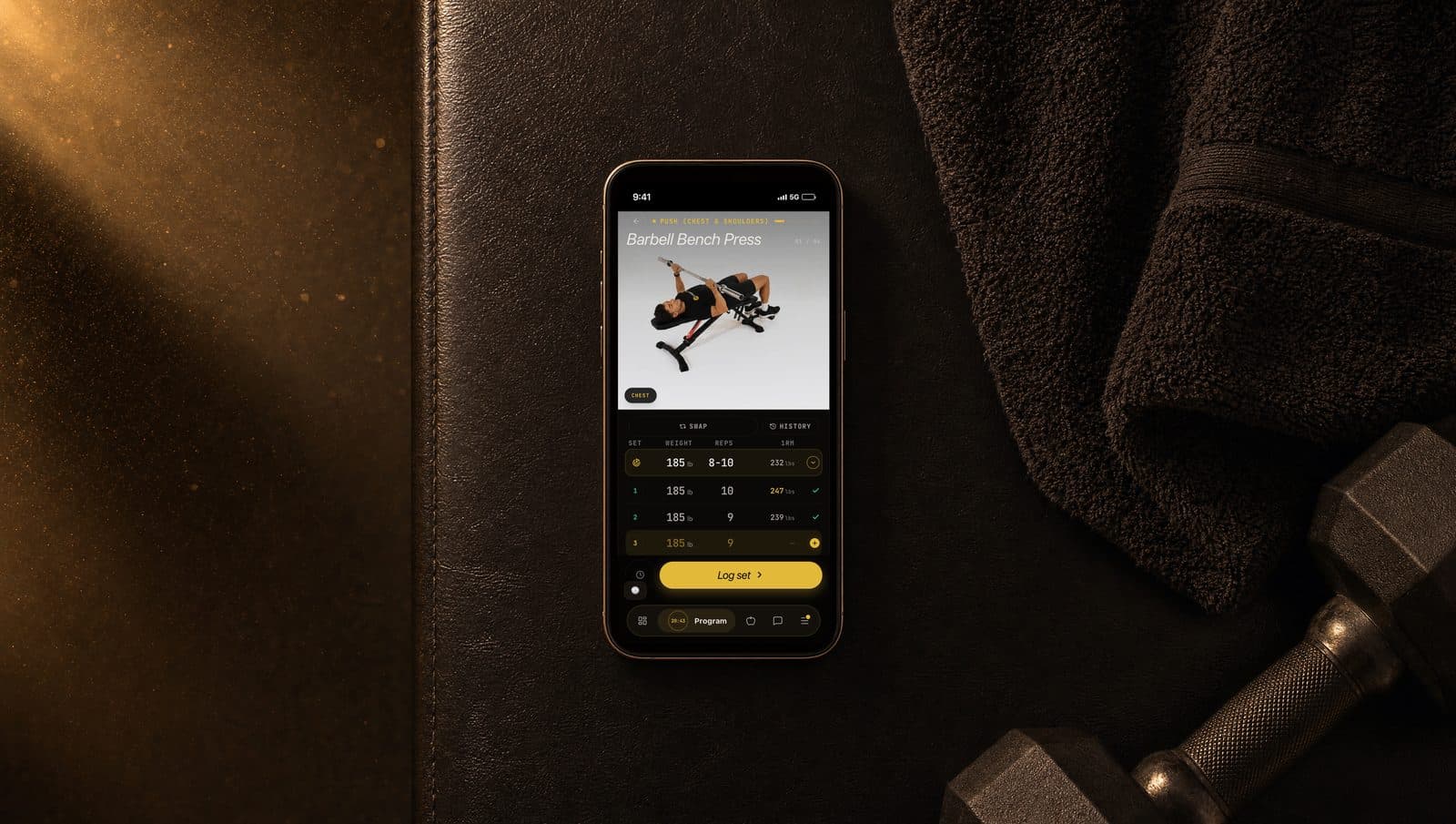
The engine reads your RPE on every set and feeds it forward to the progression decision.
If you logged RPE 7 across the week and the target was RPE 7, weight goes up next session. If you logged RPE 9 and the target was 7, weight holds or drops. If you logged RPE 5 on a target of 7, the engine raises the weight a bit more aggressively. This is autoregulation, and it's what keeps you on the right side of the line between productive stress and overreach.
Two hard gates protect you regardless of what the autoregulation wants to do.
The first: any working set logged at RPE 9.5 or higher blocks weight progression on that exercise next session. A 9.5 means half a rep left in the tank. Going up from there invites form breakdown.
The second: if your average RPE for the day was 8.5+ AND any single set hit 9.0+, progression is blocked across the whole session. This catches days where everything was just slightly too hard.
You can train hard. You cannot train past where your body is ready to be.
The fatigue guardrail watches what you can't
Recovery is hard to feel until it's too late. By the time you "feel run down," you're already three weeks deep into a fatigue debt that will take a deload to clear.
The fatigue guardrail watches signals you can't reliably feel.
It tracks your average weekly sleep. If sleep drops too low for too long, working sets are cut by 20 to 30 percent for the coming week and heavy compound work is blocked. It tracks your stress check-ins. If chronic stress shows up, volume eases. It tracks your soreness reports. If you're carrying residual soreness into multiple sessions, the engine slows the ramp.
You don't have to remember to report any of this. Your daily check-in feeds the system, and the system acts.
Automatic deloads when something is wrong
Your program has a scheduled deload every 4 to 6 weeks regardless of how you feel. That's the planned recovery cycle.
Two separate triggers can force an unscheduled deload on top of that.
Strength regression on compound lifts. If your squat, bench, deadlift, overhead press, or row drops 5 percent or more below its recent peak across two consecutive sessions, a deload triggers immediately. Sustained regression on compound movements is the most reliable early warning sign of overreach.
Sustained high RPE. If your weekly average RPE exceeds 9.0, a deload triggers. You should not be training near failure on every set every week. That's a recipe for the kind of fatigue that takes months to clear.
These are not suggestions. The engine deloads you without asking, and your next week's program reflects it.
What you can override and what you can't
The whole point of the safety system is that some things are out of your hands. The list of what you can't override is short and intentional.
You cannot override an injury contraindication. If you flagged your lower back, you cannot ask the coach for a deadlift program. The chat will redirect you to safer alternatives.
You cannot override the fatigue guardrail. If your sleep data triggers it, volume is reduced regardless of what you ask.
You cannot get the coach to recommend a banned substance. Anabolic steroids, SARMs, prohormones, DNP, and the rest of the obvious list are not on the table. The coach will redirect every time.
What you can do: update your profile when something changes. Heal an injury, take the flag off, and the exercises come back. Lose weight, watch the loads scale up. Have a real conversation with the coach about intensity inside the safe range.
What to do next
Open your Profile tab and look at your injury flags. If any of them are stale (an injury healed, a new one cropped up), update them now. The change propagates to your next training session.
If you're not logging RPE consistently, start. It's the single highest-leverage number you can give the engine. One number per working set, and the engine can autoregulate everything else.