Progressive Overload: The Only Rule That Matters
Progressive Overload: The Only Rule That Matters
If your weights and reps don't move, your body doesn't change.
Read that again. It's the entire game.
Every training principle you've ever heard about (high volume, low volume, push-pull-legs, full body, conjugate, whatever) is downstream of one rule: over time, the work has to get harder. More reps. Heavier weight. Better technique. Something. If nothing moves, you're paying a gym membership to maintain.
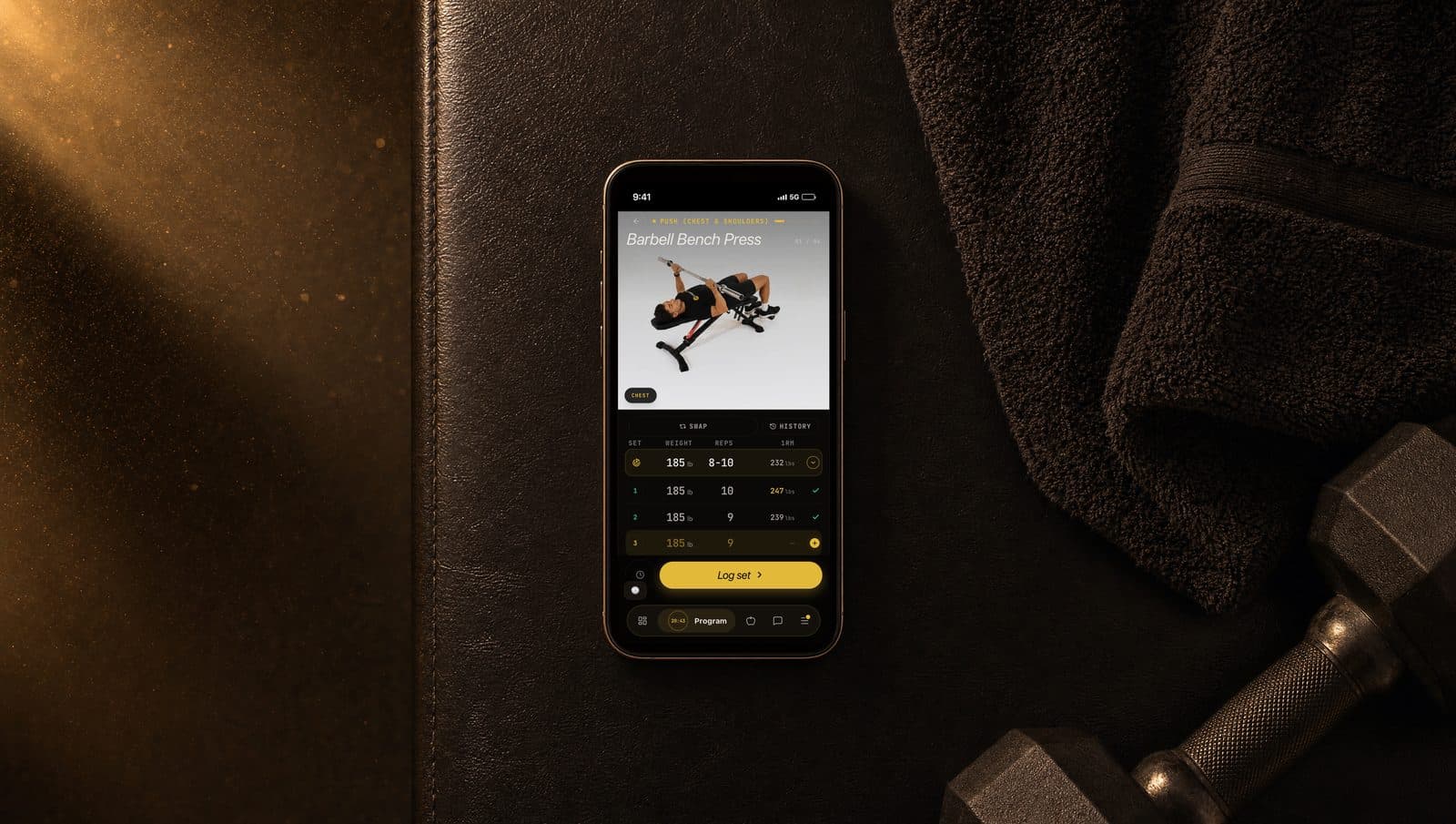
The app forces that progression for you, automatically, in a way that doesn't break your form or your joints. Here is exactly how.
What "harder over time" actually means
Your body adapts to stress. The first time you bench 135 for 8 reps, it's stress, you adapt, you grow. The hundredth time you bench 135 for 8 reps, your body has already adapted. There's no signal left to grow.
So the work has to escalate. But escalate too fast and you wreck your form, drown in fatigue, and get hurt. Escalate too slow and you leave gains on the table.
The trick is a method that escalates exactly fast enough. That method is double progression.
How double progression works
You have two levers. Reps first. Weight second.
Every exercise in your program has a rep range, like 8 to 12 reps. Your job is to live inside that range and climb. Every session, try to add a rep or two while keeping form clean and RPE on target.
When you can hit the top of the range across your working sets, the app bumps the weight. You drop to the bottom of the rep range at the heavier load and start climbing again.
That's it. That's the whole loop.
Here's what it looks like on bench press programmed for 8 to 12 reps at 155 pounds:
- Week 1: 155 x 9, 9, 8 (building)
- Week 2: 155 x 10, 10, 9 (improving)
- Week 3: 155 x 12, 12, 11 (almost there)
- Week 4: 155 x 12, 12, 12 (ceiling hit, weight goes up)
- Week 5: 160 x 9, 8, 8 (new weight, start over)
Slow? Maybe. Sustainable? For years.
Most lifters fail because they try to add weight every session. That works for six weeks. Then it stops working. Then they get frustrated, jump too hard, hurt themselves, and quit. Double progression is the antidote.
The 80 percent rule
The app doesn't demand perfection before raising the weight.
If you have 4 working sets and you hit the top of your rep range on at least 80 percent of them, weight goes up next session. Three out of four counts. Four out of five counts. Five out of six counts.
If you only hit it on two of four, weight holds. You haven't earned the jump yet.
This threshold is calibrated to balance ambition with consistency. You proved mastery of the current load on most of your sets. The single set that fell a rep short isn't a reason to wait another week.
How much weight gets added
Equipment determines the jump size. Big lifts get bigger jumps. Small lifts get smaller jumps.
| Equipment | Jump | |-----------|------| | Barbell compounds (squat, bench, deadlift, OHP, row) | +5 lbs | | Dumbbell compounds | +5 lbs (+2.5 per hand) | | Dumbbell isolation (curls, lateral raises) | +2.5 lbs | | Cable | +2.5 lbs | | Machine | +5 lbs | | Bodyweight | reps and RPE only |
These look conservative because they are. A 5-pound jump on a 200-pound squat is a 2.5 percent increase. A 5-pound jump on a 25-pound lateral raise is a 20 percent increase. The second one breaks your form. That's why isolation work gets the smaller increment.
If your gym has fractional plates and you want to micro-load between standard jumps, the chat coach can adjust your starting weight by 1 or 2.5 pounds.

RPE is the safety brake
Hitting your rep target isn't enough by itself. The app also checks how hard those sets felt.
RPE (Rate of Perceived Exertion) is a 1-to-10 scale that maps directly to reps in the tank:
| RPE | What it felt like | Reps left | |-----|-------------------|-----------| | 10 | Failure. Could not have done another rep. | 0 | | 9 | One rep left if you really needed it. | 1 | | 8 | Two reps left. Hard. | 2 | | 7 | Three reps left. Solid working set. | 3 | | 6 | Four or more reps left. Felt easy. | 4+ |
Two gates block weight progression even when you hit your reps:
Gate one. Any single working set logged at RPE 9.5 or higher blocks the next progression on that exercise. A 9.5 means half a rep left in the tank. Going heavier from there invites form breakdown.
Gate two. If your average RPE across working sets is 8.5+ AND any single set hit 9.0+, progression blocks across the whole session. This catches the day where everything was just a hair too hard.
Hitting 12 reps at RPE 9.5 is not the same as hitting 12 reps at RPE 7.5. The first is a grind. The second is genuine capacity. The app rewards the second.
How your starting weights got picked
The first session in any program is a calibration session, not a max-out.
The engine estimated your starting weights from your bodyweight, sex, experience level, and the equipment type. A beginner male starts at a fraction of his bodyweight on the bench. An intermediate starts at a higher fraction. These ratios are calibrated against published strength standards and intentionally conservative.
If those starting weights felt too light, log them honestly with low RPE. The app sees the low RPE and ramps you up faster than the default progression.
If they felt too heavy, log that too. The engine drops the next prescription.
Estimating your 1RM as you train
Your one-rep max is the heaviest weight you can lift once. You don't have to test it. The app estimates it from your working sets.
It averages two validated formulas: Epley and Brzycki. Each formula has biases at different rep ranges. Averaging them produces tighter estimates across the board.
If you want to see your current estimated 1RM on any of the big lifts right now without waiting for the engine to compute it:
Your estimated 1RM is also how the app picks loads when you ask for a percent-based program (5x5, 5/3/1, etc.).
What happens when you stall
Stalls are normal. They are not a problem to panic about.
A "stall" means no exercise in your program went up in weight across a full week. The app sees that and reads it alongside your other recovery signals: average RPE, sleep, soreness, readiness score.
A stall by itself isn't enough to force a deload. The app needs to see at least one other signal pointing the same direction. But by week 6 of training, a deload is enforced regardless of how good you feel. Your body has accumulated more fatigue than you're aware of.
What to do next
Open the Program tab and look at your current week. Your prescribed loads are sitting there waiting.
For your next session: hit your prescribed weight, log every working set's reps, and log RPE honestly on each one. Don't round down. Don't round up. The system learns from accurate inputs and gets confused by flattery.
A month from now your numbers will be measurably higher than they are today. That's not a hope. That's the math.