Your Macros, Explained: Every Number, Every Formula, Zero Mystery
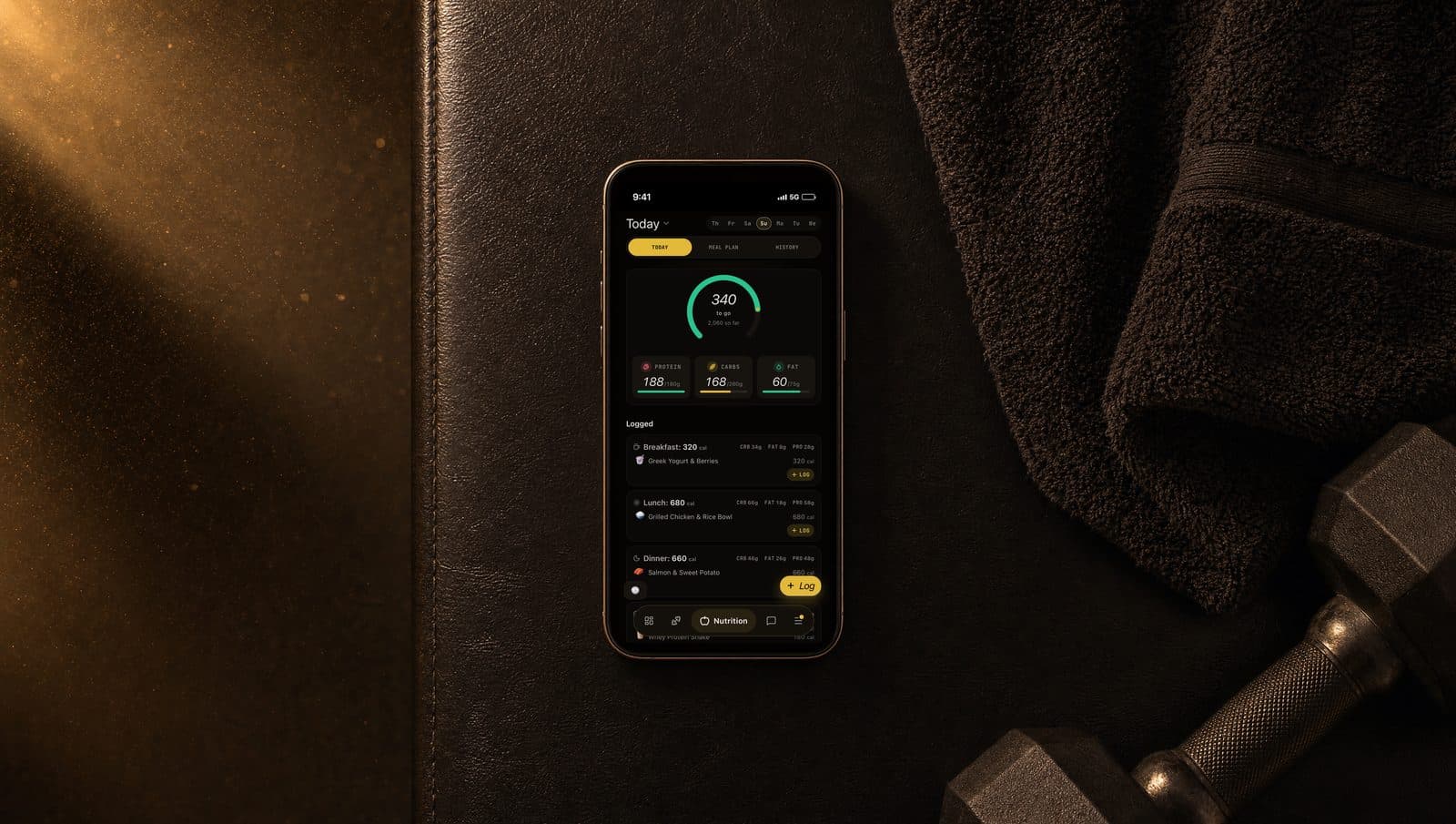
Your Macros, Explained: Every Number, Every Formula, Zero Mystery
Most apps hand you a calorie target and a protein number and expect you to trust them.
This one shows the math.
Your daily targets come out of a 5-step calculation. Every step uses peer-reviewed formulas. Every assumption is visible. By the end of this article, you'll be able to verify your own numbers in 60 seconds with a calculator.
Here is exactly how it works.
Step 1: Your Basal Metabolic Rate
Your BMR is the calories your body burns at complete rest. Breathing, circulating blood, keeping you alive. Everything else builds on this.
Two formulas, depending on what data you've given us.
If you've entered body fat percentage, the engine uses Katch-McArdle because it accounts for lean mass:
Lean Mass (kg) = weight_kg × (1 - body_fat_pct / 100)
BMR = 370 + 21.6 × lean_mass_kg
Two people at the same bodyweight can carry very different amounts of muscle versus fat. A 90 kg lifter at 15% body fat has way more metabolically active tissue than a 90 kg person at 30%. Katch-McArdle catches that.
If you haven't entered body fat, the engine falls back to Mifflin-St Jeor, validated as the most accurate general-population BMR formula:
BMR = 10 × weight_kg + 6.25 × height_cm − 5 × age + offset
Where offset is +5 for males, −161 for females.
Worked example. A 30-year-old male, 75 kg, 178 cm: BMR = 750 + 1112.5 − 150 + 5 = 1,717 kcal/day.
Add body fat to your profile later and the engine switches to Katch-McArdle automatically.
Step 2: Total Daily Energy Expenditure
BMR is the calories at rest. TDEE adds the movement you actually do.
TDEE = BMR × Activity Multiplier
| Activity Level | Multiplier | What it means | |----------------|------------|----------------| | Sedentary | 1.2 | Office job, minimal movement | | Lightly Active | 1.375 | Light exercise 1 to 3 days a week | | Moderately Active | 1.55 | Real exercise 3 to 5 days a week | | Active | 1.725 | Hard training 6 to 7 days a week | | Very Active | 1.9 | Athlete or physical job plus exercise |
Pick the level that matches your overall week, not your hardest day.
Continuing the example. Our 75 kg male trains 4 days a week (Moderately Active): TDEE = 1,717 × 1.55 = 2,662 kcal/day.
Step 3: Goal-adjusted calories
Eating at TDEE maintains your weight. To change your body, the engine applies a calorie multiplier based on your goal.
| Goal | Multiplier | Daily Target | |------|------------|--------------| | Fat Loss | 0.80 (20% deficit) | TDEE × 0.80 | | Muscle Gain | 1.10 (10% surplus) | TDEE × 1.10 | | Body Recomposition | 1.00 | TDEE | | Strength | 1.05 (5% surplus) | TDEE × 1.05 | | Powerbuilding | 1.10 (10% surplus) | TDEE × 1.10 |
These multipliers are deliberately moderate. Crash diets and massive bulks produce faster short-term results and worse long-term ones. Moderate adjustments win on every horizon beyond 8 weeks.
Continuing the example, muscle gain: 2,662 × 1.10 = 2,928 kcal/day.
Step 4: The macro split (protein first, fat second, carbs last)
The engine doesn't divide calories evenly. Macros get allocated in priority order.
Protein first
Protein is set first because the evidence base is strongest and getting it wrong has the biggest consequences.
| Goal | Protein | |------|---------| | Fat Loss | 2.2 g/kg bodyweight | | Muscle Gain | 2.0 g/kg | | Body Recomposition | 2.4 g/kg | | Strength | 2.0 g/kg | | Powerbuilding | 2.2 g/kg |
Higher protein in a deficit protects lean mass and increases satiety. Body recomposition gets the highest setting because at maintenance calories, maximum protein is what drives the recomp signal.
Continuing the example, 75 kg muscle gain: 75 × 2.0 = 150 g protein/day (= 600 kcal at 4 kcal per gram).
Fat second
Fat is essential for hormone production (including testosterone), cell membranes, and absorbing vitamins A, D, E, K.
| Goal | Fat % of calories | |------|-------------------| | Fat Loss | 25% | | Muscle Gain | 25% | | Body Recomposition | 25% | | Strength | 30% | | Powerbuilding | 25% |
Strength-focused goals get the higher allocation to support hormonal health under heavy loading. Nobody goes below 25%, which is the minimum for healthy endocrine function.
Continuing the example: 2,928 × 0.25 = 732 kcal → 732 / 9 = 81 g fat/day (9 kcal per gram).
Carbs fill what's left
Carbs are your primary fuel for resistance training and high-intensity work. They're also the most flexible macro. The body adjusts glycogen usage based on activity, while protein and fat have stricter requirements.
Carb kcal = Total kcal − Protein kcal − Fat kcal
Carb grams = Carb kcal / 4
Continuing the example: 2,928 − 600 − 732 = 1,596 kcal → 399 g carbs/day.
Final macro summary (75 kg male, moderately active, muscle gain):
| Macro | Grams | Calories | % | |-------|-------|----------|---| | Protein | 150 | 600 | 20% | | Fat | 81 | 732 | 25% | | Carbs | 399 | 1,596 | 55% | | Total | | 2,928 | 100% |

Step 5: Training days vs rest days
Your body doesn't need the same fuel on a rest day as on a training day. The engine generates two targets.
Training days: full calculated target.
Rest days: reduced calories, with the reduction coming entirely from carbs. Protein and fat stay the same.
| Goal | Rest day cut | |------|--------------| | Fat Loss | −15% | | All other goals | −10% |
Protein stays constant to maintain muscle protein synthesis around the clock. Fat stays constant to support hormones. Carbs flex because that's the macro your body adjusts most readily to activity level.
Continuing the example, rest day: 2,928 × 0.90 = 2,635 kcal. Protein 150 g (unchanged). Fat 81 g (unchanged). Carbs = (2,635 − 600 − 732) / 4 = 326 g.
What else the engine sets
Beyond the four big numbers, you get a few targets you might not notice:
- Fiber: roughly 14 g per 1,000 kcal, capped between 25 g and 38 g per day. Supports digestion, satiety, and blood sugar.
- Meal timing: loose goal-based guidance. Fat loss plans cluster carbs around your workout window. Muscle gain plans distribute carbs more evenly.
- Supplements (when relevant): the coach recommends from a small evidence-backed whitelist (creatine, whey protein, caffeine, vitamin D, fish oil, magnesium). Never anabolic steroids, SARMs, prohormones, DNP, or anything banned.
When your targets update automatically
Your macros aren't frozen. They recalculate when relevant inputs change.
Weight change. A new weight log triggers recalc because BMR and protein both depend on bodyweight.
Activity level change. Switching from "Moderately Active" to "Active" raises your TDEE multiplier and everything downstream.
Goal change. Flipping from Fat Loss to Muscle Gain changes the calorie multiplier, protein ratio, and fat percentage simultaneously.
To avoid pointless churn in your meal plan, the engine only regenerates the plan when your recalculated calorie target shifts by 200 kcal or more. Smaller changes update your displayed targets but leave your current meals alone.
You can override the calculation entirely
If a dietitian or coach gave you specific numbers, ask the chat coach to set them directly.
- "Set my protein to 180 g and calories to 2,500."
- "I want my fat at 80 g."
The coach applies the override and flags your profile as having custom macros. Auto-recalculation pauses. The override sticks until you say "reset my macros to calculated."
What to do next
Open the Meal Plan tab. Your current macro targets are at the top.
Plug your bodyweight, height, age, and sex into the formulas above. Pick your activity multiplier. Apply your goal multiplier. The number on your screen should match what the math says (within rounding).
If it doesn't match, check whether your profile has a custom override flag. The coach can show you in chat.