When to Trust the Numbers, When to Trust the Mirror
When to Trust the Numbers, When to Trust the Mirror
The scale lies.
The mirror lies.
Your lifts mostly tell the truth.
If you only watch one metric, you'll get fooled. If you watch the right combination in the right hierarchy, you'll know exactly what's happening and what to change.
Here's the hierarchy of progress metrics and what each one is good for.
The scale: useful but volatile
The number on the scale measures total bodyweight. Total bodyweight is the sum of fat, muscle, water, glycogen, and the food in your gut.
Most of those vary day to day. Water alone swings 3 to 5 pounds depending on hydration, sodium intake, time of day, and time of month.
What the scale is good for:
- Long-term trend tracking (4+ weeks).
- Detecting when you're on or off a calorie target.
What the scale is bad for:
- Daily judgment of how the program is going.
- Detecting body composition changes (recomp).
- Determining whether you're "fat" or "lean."
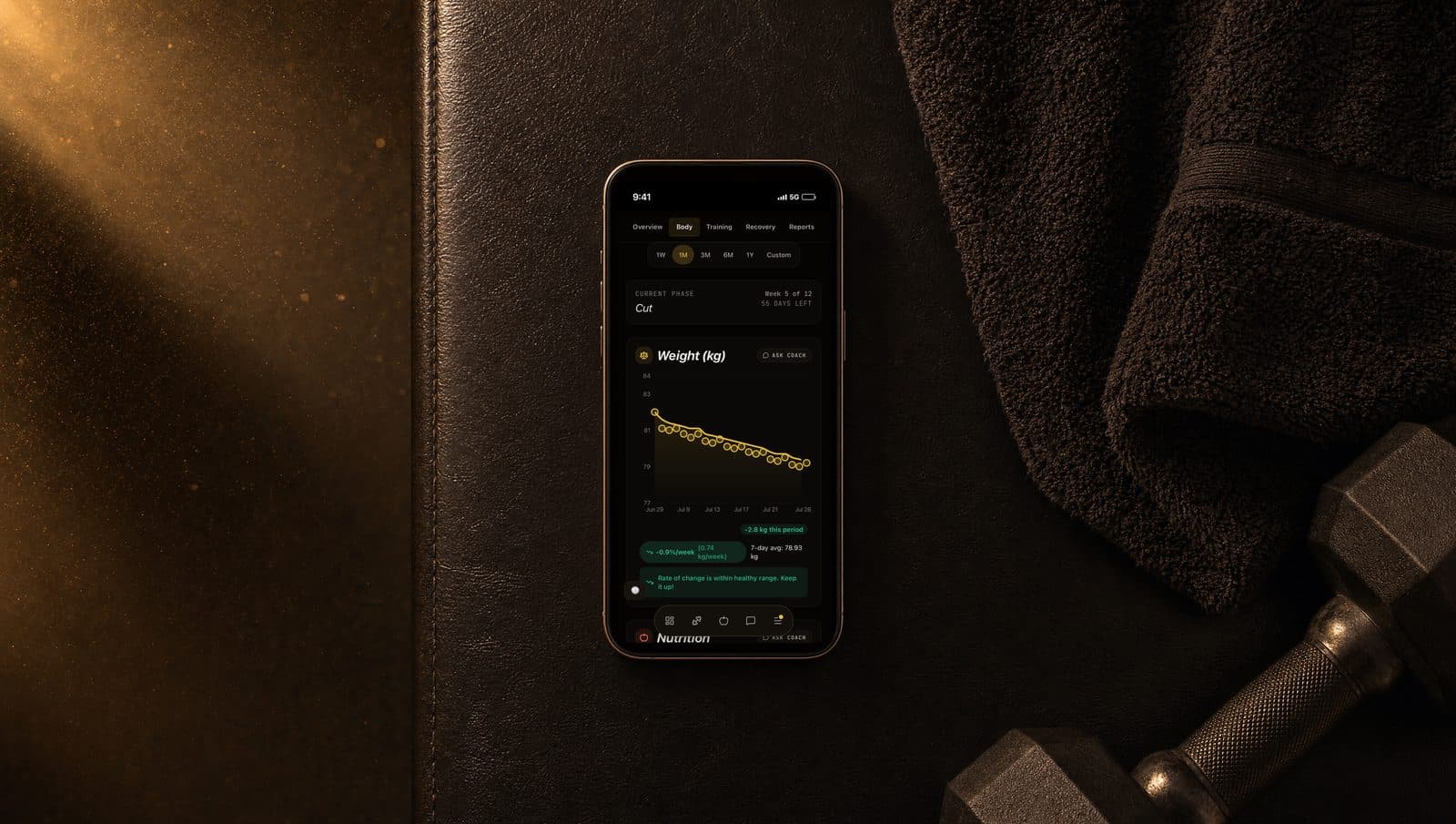
The rule: use a 7-day rolling average, not single-day weights.
Weigh yourself daily, same time, same conditions (first thing in the morning, after the bathroom, before eating or drinking). Then look at the rolling average. The 7-day average is what's real. Individual days are noise.
If you can't weigh daily, weigh weekly on the same day under the same conditions. Don't weigh "whenever." The variance is too high.
The mirror: useful but biased
The mirror shows you your actual physical form, which is what most people are training for.
The problem is that you see yourself every day, which makes daily change invisible.
Imagine a friend who you only see once every 3 months. You notice their physical changes instantly because you're comparing across a 90-day gap.
You don't have that perspective on yourself. You compare yourself to yesterday. Yesterday and today look essentially identical. So you conclude "nothing is happening" even when meaningful changes are occurring across weeks.
What the mirror is good for:
- Long-term body composition assessment (with the right protocol).
- Catching dramatic changes that the scale missed.
What the mirror is bad for:
- Daily progress assessment.
- Honest self-image (you'll oscillate between thinking you look great and thinking you look terrible, with no real change underneath).
The rule: progress photos, not daily mirror checks.
Take photos every 2 to 4 weeks. Same lighting. Same time of day. Same outfit. Same camera angle. Same poses. The comparison across photos shows you what the daily mirror can't.
Mirror at random times of day under random lighting is worse than no mirror at all. It introduces false signal.
Your lifts: the most honest metric
If you trained hard enough yesterday to go up in weight or reps today, you grew. The bar doesn't lie.
What lifts are good for:
- Real-time progress tracking. Lifts trending up over 4 weeks = you're growing. Lifts trending down = something's wrong.
- Detecting plateaus early.
- Confirming the program is working regardless of what the scale shows.
What lifts are bad for:
- Body composition assessment. You can get stronger without looking different. You can also look better without getting much stronger.
The rule: track estimated 1RM trend on your main compounds.
Squat, bench, deadlift, OHP, row. Their trend across 4 to 8 weeks is the strongest signal that your program is working.
The app calculates estimated 1RM automatically from your logged sets. Open the Stats tab and look at the trend.
Body measurements: useful, underused
Body measurements (waist, hip, chest, arm, thigh) catch composition changes the scale and the mirror miss.
In a cut: waist usually drops faster than scale weight. You can lose 1 inch off your waist while only seeing 4 to 6 pounds on the scale. That's good news.
In a bulk: arm circumference and chest can go up before the scale moves much. The muscle is growing.
In a recomp: this is the only metric that reliably shows what's happening because the scale won't move much.
The rule: measure every 4 weeks. Same conditions. Track the trend.
Use a flexible measuring tape. Same time of day, same anatomical landmark each time. Record in your check-ins or in a notes file.
How to use them together
The metrics aren't independent. They tell different parts of the same story.
| Situation | Scale | Lifts | Photos | Measurements | |-----------|-------|-------|--------|--------------| | Cutting well | Down 0.5 to 1 lb/week | Maintained | Visibly leaner over 4-6 weeks | Waist down | | Bulking well | Up 0.5 to 1 lb/week | Up | Visibly bigger over 8-12 weeks | Arms/chest up | | Recomp working | Flat | Up | Slowly better over 12-16 weeks | Waist down, arms up | | Something wrong: too aggressive cut | Down too fast | Dropping | Looking smaller, not leaner | Waist down, arms down | | Something wrong: stalled bulk | Flat or down | Flat | No change | No change | | Something wrong: water/sodium spike | Up 3+ lbs in one day | Same | Same | Same |
The decisive read: if your lifts are going up and the scale is moving in the right direction at the right rate, you're winning regardless of what the mirror says today.
The most important override: if the scale says you're losing weight but your lifts are crashing, you're losing muscle. Eat more.

The daily check vs the monthly truth
A useful frame: the daily metrics are noise. The monthly metrics are signal.
Daily noise (ignore these):
- Today's single bodyweight reading.
- Today's mirror impression.
- How you felt during one workout.
- How your stomach looks after a single meal.
Weekly signal (use these):
- 7-day moving bodyweight average.
- This week's average RPE trend.
- This week's macro adherence percentage.
- Lifts compared to last week.
Monthly truth (these don't lie):
- Bodyweight trend across 4 weeks.
- Strength on major lifts vs 4 weeks ago.
- Progress photos compared to 4 weeks ago.
- Body measurements compared to 4 weeks ago.
If you only check the daily noise, you'll constantly feel like nothing is happening. If you only check the monthly truth, you'll miss issues until they're large. Use all three timescales appropriately.
How the app handles this
The Stats tab is structured around these timescales.
The Overview shows you the noise and the signal: today's snapshot, this week's hero stats, the activity heatmap.
The Body & Nutrition subtab shows the trend lines: 7-day moving bodyweight average, weekly nutrition adherence, monthly composition changes.
The Training subtab shows lifts: estimated 1RM trends per exercise across weeks, volume by muscle group, average RPE per week.
The Reports subtab is where the coach distills the data into a weekly assessment of what's working and what's drifting.
Use the right tab for the right question. Don't check daily weight in the Overview and judge the program by it. Check the Body & Nutrition trend across 4 weeks and judge by that.
Common mistakes
Weighing yourself in the evening after eating and panicking. Your weight is highest at this time of day. It's not real weight gain. Always weigh first thing in the morning, after the bathroom, before eating.
Checking the mirror after a salty meal. You're holding water. You will look bloated. This is not fat. Wait 24 to 48 hours.
Treating one bad weight as a trend. One day. One number. Out of 365. It's noise.
Ignoring the lifts because "I don't care about strength, I care about looking better." Your lifts are the most honest indicator that the program is producing the adaptation that produces the look. If your lifts are dying, your look will follow.
Taking progress photos in different lighting every time. Compare a 6am bathroom selfie to an 8pm bedroom mirror selfie and you'll think you regressed. Standardize the conditions.
Trusting body fat scales. Home bioelectrical impedance scales (the kind that show body fat percentage) are unreliable. Daily readings can vary 5+ percentage points based on hydration. Use them for general trend only, not absolute values.
What to do next
This week:
- Weigh yourself daily, same conditions. Watch the 7-day average, ignore daily spikes.
- Take one progress photo. Same lighting and outfit you'll use 4 weeks from now.
- Measure your waist, chest, and one arm (relaxed). Write it down.
- Look at your big lift trends in the Stats tab. Are they trending up over the last 4 weeks?
If all four signals are pointing the right way, you're doing this right. The mirror catching up is just a matter of time.