Daily Check-ins: 30 Seconds That Reshape Next Week's Program
Daily Check-ins: 30 Seconds That Reshape Next Week's Program
A daily check-in takes 30 seconds.
That 30 seconds is the single highest-leverage thing you can do for your training. Every field you fill in becomes a decision the engine makes about next week's program. Skip the check-in and the engine is guessing about your recovery, your sleep, your fatigue. Do the check-in and the engine is coaching.
This article walks through every field, what fires off that field, and why a 30-second habit beats a 30-minute training journal you abandon in three weeks.
What gets captured in 30 seconds
Each daily check-in collects up to 9 data points. Several auto-populate from your workout logs and connected health platform. The rest take a few taps.
- Workout completion. Did you train today? Yes or no. If you skipped, you can add a reason (sick, travel, life). Reasons are not judged. They're used to distinguish intentional rest from disruption.
- RPE. How hard the session felt, 1 to 10. Subjective effort, not heart rate.
- Fatigue. Overall tiredness, 1 to 10. Different from workout difficulty. You can feel fatigued on a rest day.
- Sleep hours. Last night's sleep in decimal hours (7.5, not 7h 30m). A reasonable estimate is enough.
- Soreness. 1 to 10. Persistent high soreness means recovery is lagging the stimulus.
- Stress. Life stress, 1 to 10. Work, family, finances. All of it counts because it all affects your ability to recover.
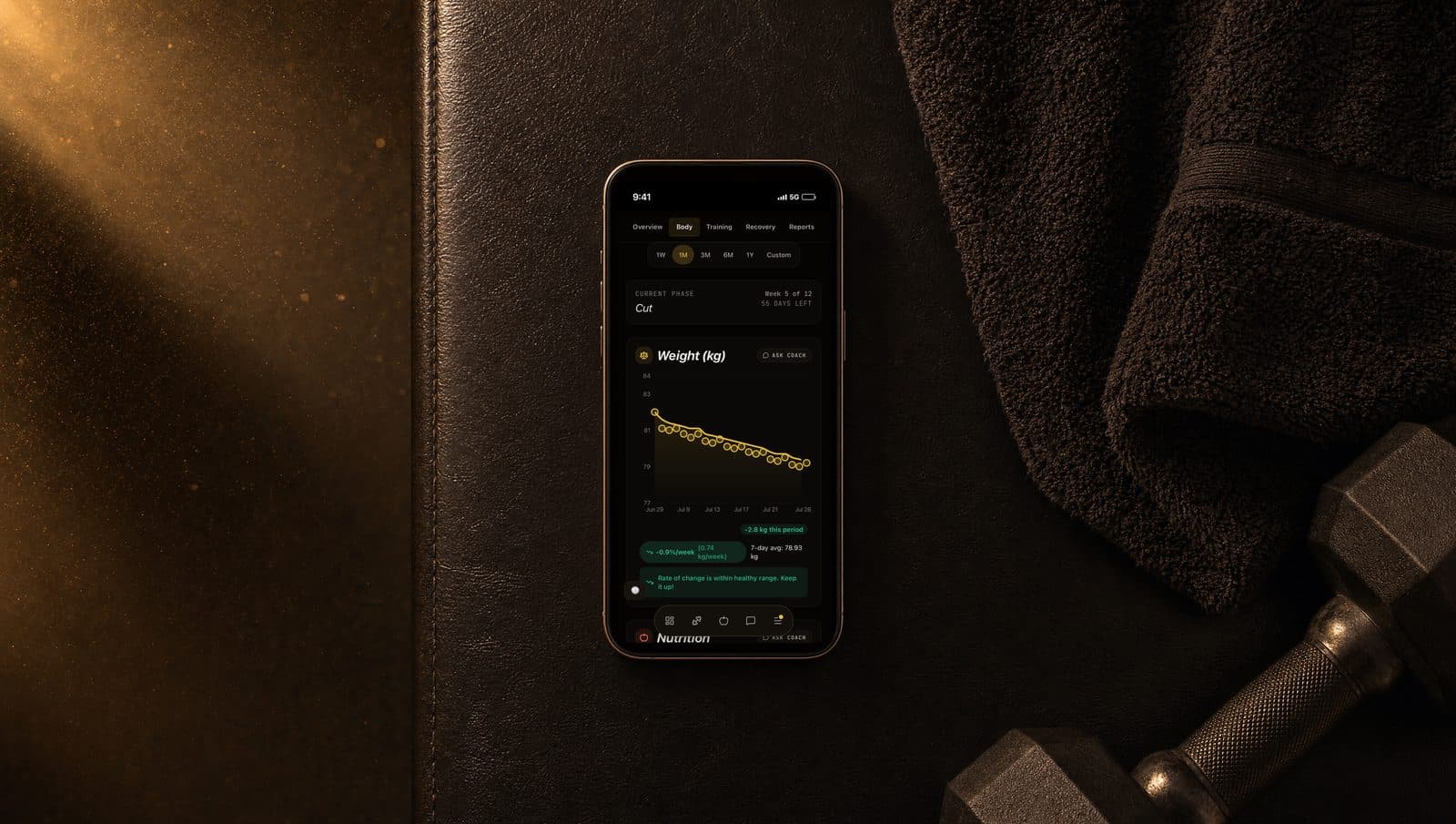
- Bodyweight. Today's weight in your unit. The engine uses a rolling average so single fluctuations don't move anything.
- Nutrition. Pulled automatically from your food logs or connected health platform. No manual entry needed if you're already logging meals.
- Notes. Free-text field. Traveling. Knee tight on squats. New meds. Slept terribly. This is how you give the engine context the numbers cannot capture.

Why every field matters
None of these fields exist for fun. Each one maps to a specific decision the engine will make.
RPE drives progression. Consistently low RPE at prescribed weight means you're ready for more. Consistently high RPE means hold or pull back. RPE is the single most important number for autoregulation.
Sleep and stress are guardrails. If your average sleep drops below 6 hours OR your average stress exceeds 7 out of 10, the engine enforces a mandatory 20 to 30% volume cut. Not a suggestion. A guardrail. Chronically sleep-deprived or stressed lifters cannot recover from normal training volumes. The engine would rather give you an easier week than let you dig a hole you can't climb out of.
Fatigue and soreness trigger deloads. Average fatigue at or above 7.0 contributes to deload triggers alongside RPE and performance decline. High soreness on specific body parts can trigger exercise swaps before a minor issue becomes a tweak.
Bodyweight feeds trend analysis. The engine uses 7-day rolling averages to filter out daily fluctuations from water, sodium, meal timing. If your weight rate of change suggests you're losing or gaining too fast for your stated goal, you get a weight rate alert.
Nutrition adherence shapes the next adjustment. Consistently low macro adherence may dial back training volume (you don't have the fuel for hard sessions). Consistently high adherence with stalled progress may prompt a calorie adjustment.
Notes are how you give the engine eyes. "Traveling this week" explains why your adherence dropped. "Knee tight on squats" may trigger an exercise swap. The engine cannot see your life. The notes field is how it sees enough to make smart calls.
Your consistency score
Your check-in data is distilled into a single weekly number measuring overall consistency. The score weights four components.
Tracking consistency. Did you log food at all? Simply tracking counts, even if your macros were off. A tracked day always scores higher than an untracked one.
Target accuracy. How close were you to your macro targets? This is a gradient, not pass/fail. Hitting 80% of your protein target scores meaningfully higher than 50%, even though neither is perfect.
Improvement trend. Are you getting more accurate week over week? Adherence climbing from 60% to 78% rewards the trajectory regardless of where you started.
Workout adherence. What percentage of planned sessions did you complete?
The score philosophy is progress over perfection. A day where you tracked food but missed your protein target by 30 grams scores around 50. A day where you didn't track scores zero. The data shows lifters who track imperfectly but consistently outperform lifters who track perfectly for two weeks and then quit.
How your check-ins shape next week
All daily data aggregates into a weekly summary. That summary is what the engine reads when it rewrites next week's program.
The summary includes:
- Missed workouts and their reasons
- Weekly averages for RPE, fatigue, sleep, stress (compared against the prior 3 weeks to spot trends)
- Macro adherence percentage
- Any schedule changes you flagged in chat or notes
This is the bridge between your 30-second check-in and the intelligent weekly adjustments that keep your training aligned with reality.
Five rules for check-ins that stick
Set a reminder for the same time daily. Morning works well. Log last night's sleep, today's bodyweight, yesterday's soreness while it's fresh.
Don't overthink the numbers. A fatigue 5 vs a 6 doesn't change anything downstream. The engine reads trends across weeks, not single points. Pick the number that feels right and move on.
Use the notes field liberally. Even a few words help. "Slept badly," "felt strong," "knee tight" all give the engine context the numbers can't.
Weigh yourself at the same time. First thing in the morning, after the bathroom, before eating or drinking. Minimizes noise in the data.
Check in on rest days too. Rest-day data (sleep, fatigue, stress, soreness) is just as valuable as training-day data. Recovery doesn't pause on off days.
What to do next
If you haven't checked in today, do it now. 30 seconds.
If you haven't been checking in consistently, set a daily reminder. The exact time matters less than picking one and sticking with it.