Cutting vs Bulking: How to Choose, How to Win
Cutting vs Bulking: How to Choose, How to Win
You cannot meaningfully build muscle and lose fat at the same time.
Read that twice. It's the most important sentence in fitness nutrition.
Yes, certain populations can do both simultaneously (true beginners, returning lifters with muscle memory, dramatically overweight individuals). For everyone else (intermediate and advanced trainees at reasonable bodyfat), you have to pick.
Bulk = gain muscle, accept some fat gain. Cut = lose fat, accept some muscle loss risk. Trying to do both at maintenance = slow progress on both, which feels like no progress on either.
Here's how to pick which phase you're in and how to actually execute it.
Step one: be honest about your starting point
Before you pick a phase, look in the mirror without flattery.
Under 12% bodyfat (men) or under 20% bodyfat (women), and you want more muscle? Bulk.
Over 20% bodyfat (men) or over 28% bodyfat (women), and you want to look better? Cut.
Between those ranges? You can go either way, but pick based on what you want to fix more urgently. If you mostly want to be bigger, bulk. If you mostly want to be leaner, cut.
If you're new to lifting or coming back from a long break, your first 6 to 12 months is often body recomposition territory: maintenance calories, high protein, hard training. You'll lose fat and gain muscle simultaneously because you're untrained or detrained.
After that newbie window closes, you have to choose.
How to bulk (without becoming a marshmallow)
A bulk is a controlled calorie surplus paired with hard training. The keyword is controlled.
Target: +200 to +500 calories above maintenance. Smaller surplus is better for staying lean. Larger surplus is fine for fast gainers who need it. Most lifters do well at +300.
Target rate of gain: 0.5 to 1 pound per week. Faster than that is mostly fat. Slower than that and you might not actually be in a surplus.
Length: minimum 12 weeks. Bulks under 12 weeks rarely produce visible muscle gain. Most successful bulks run 3 to 6 months.
Protein: 0.8 to 1.0 g per pound of bodyweight. No need to go higher just because you're bulking. Calories drive growth, not extra protein beyond the threshold.
Training: progressive overload, compound-focused, high effort. Surplus calories without hard training just produce fat. The surplus is the fuel for adaptation. Train to use it.
Track weekly bodyweight, not daily. Use a 7-day average. Daily fluctuations from water and food timing will drive you nuts if you weigh in once and obsess.
The honest expectation: 5 to 12 pounds of muscle in 6 months for most lifters, plus 2 to 6 pounds of fat. The fat comes off easier than the muscle goes on. You can cut later.
When to end a bulk
Three signals tell you it's time.
- You've hit your target bodyweight or visible look. You added the size you wanted. Stop adding.
- Your bodyfat has crept too high. Past ~18% for men or ~28% for women, the marginal muscle gain isn't worth the fat. Cut and reset.
- You've been bulking for 6+ months. Most bulks plateau after this. The signal-to-noise on continued gains gets bad. Cut.
How to cut (without losing your strength)
A cut is a controlled calorie deficit that preserves muscle while reducing fat.
Target: -300 to -500 calories below maintenance. Aggressive cuts (more than -700) work fast but tax your training and recovery hard. Moderate cuts are more sustainable and protect muscle better.
Target rate of loss: 0.5 to 1 pound per week. Faster is mostly water and muscle. Slower might not be a real deficit.
Length: 8 to 16 weeks. Cuts longer than 16 weeks accumulate adaptive metabolic slowdown and hormonal compromise. If you need to lose more, do a "diet break" at maintenance for 2 to 4 weeks, then resume.
Protein: 1.0 g per pound of bodyweight, possibly higher. This is the non-negotiable. High protein during a deficit is what preserves the muscle you built during the bulk. Drop protein in a deficit and you'll lose strength fast.
Training: maintain volume and intensity from your gaining phase. Don't cut volume just because you're cutting calories. Maintenance training in a deficit is what keeps the muscle. Reducing training tells your body "this muscle isn't needed anymore."
Add walking, not hard cardio. 10,000+ steps daily. Light cardio supplements your deficit without taxing recovery. Don't add 5 hours of intense cardio on top of a deficit and hard lifting. You won't recover.
The honest expectation: 10 to 25 pounds of fat loss in 12 to 16 weeks for most lifters, while maintaining most of your hard-built muscle.
When to end a cut
- You've hit your goal bodyfat or look. Stop. Spend 1 to 2 weeks at maintenance to adapt, then either continue at maintenance or start a small surplus.
- You've stalled for 2+ weeks despite hitting your target calories. Your maintenance has dropped (adaptive thermogenesis). Either drop calories slightly or take a diet break.
- Your training is falling apart. Strength is dropping multiple weeks running, sleep is bad, motivation is gone. You've cut too long or too hard. End the cut.
Body recomposition: the only "both at once" option that works
Body recomposition is the special case where you stay at maintenance calories with very high protein and intense training, and slowly lose fat while building muscle.
This works for:
- Beginners (under 6 to 12 months of lifting)
- Returning lifters with muscle memory
- Significantly overweight individuals (who have plenty of stored energy to fuel muscle building from fat)
- Anyone coming off a long detraining period
It does not work well for intermediate or advanced lifters at moderate bodyfat. Their body has nothing easy to give. Recomp tries to use fat as fuel for muscle building, but a lean, trained lifter has too little spare fat to fuel meaningful new muscle.
If you're in the right population:
- Maintenance calories (TDEE exactly)
- 1.0 g protein per pound
- Hard training with progressive overload
- 6 to 12 month timeline
- Track measurements and photos, not just scale weight (it won't move much)
What the app does for each phase
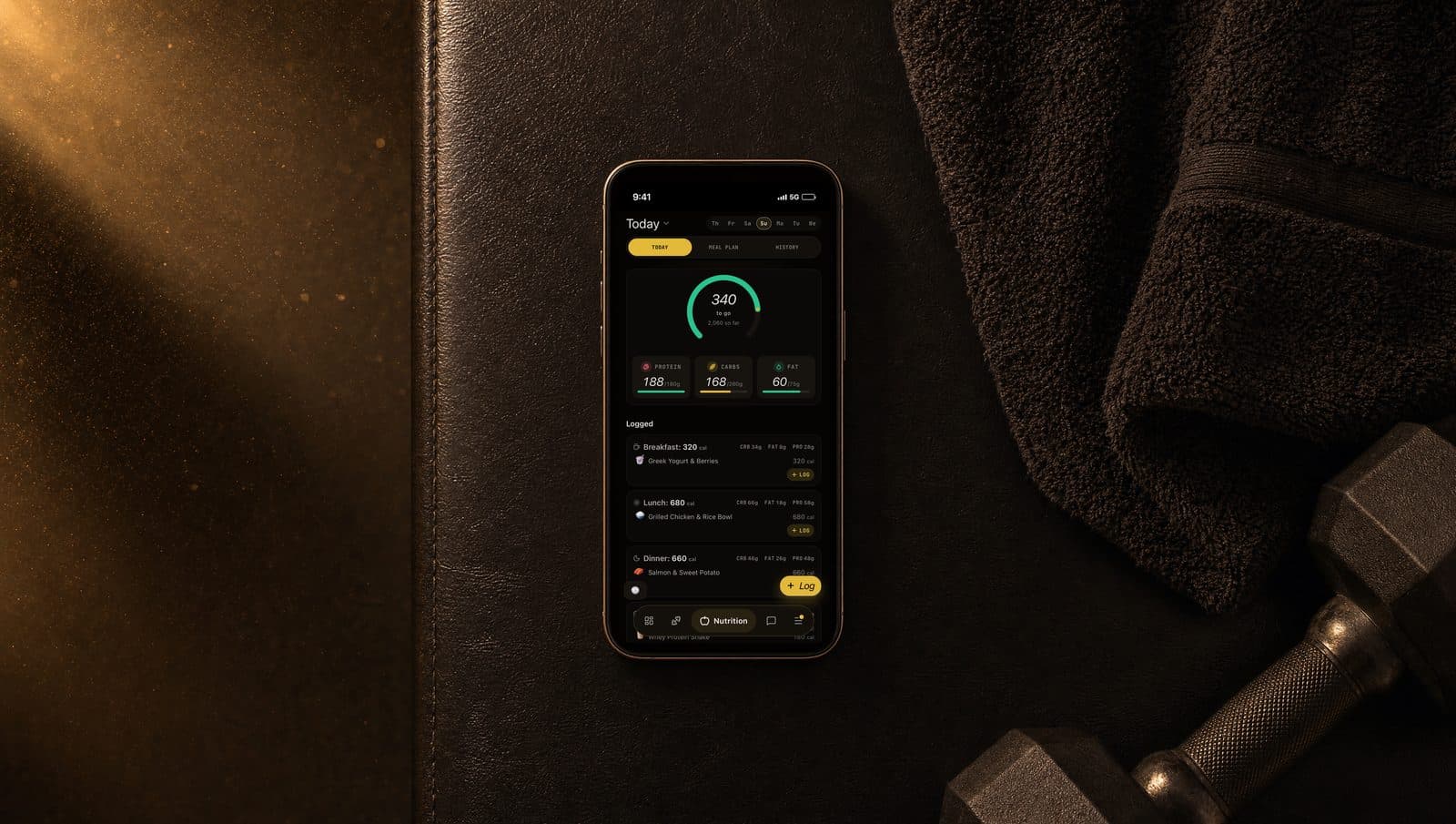
Set your goal in your Profile tab and the engine calibrates accordingly.
| Goal | Calorie multiplier | Protein | |------|--------------------|---------| | Fat Loss | TDEE x 0.80 (20% deficit) | 2.2 g/kg (~1.0 g/lb) | | Muscle Gain | TDEE x 1.10 (10% surplus) | 2.0 g/kg (~0.9 g/lb) | | Body Recomposition | TDEE x 1.00 (maintenance) | 2.4 g/kg (~1.1 g/lb) | | Strength | TDEE x 1.05 (5% surplus) | 2.0 g/kg (~0.9 g/lb) | | Powerbuilding | TDEE x 1.10 (10% surplus) | 2.2 g/kg (~1.0 g/lb) |
The training engine also adjusts: more cardio for fat loss, more emphasis on hypertrophy work for muscle gain, more conservative on volume during a deficit.

The honest timeline
Most people want results in 4 weeks. Real body changes happen on a slower clock.
Visible muscle gain on a bulk: noticeable to you at 6 to 8 weeks. Noticeable to other people at 12 to 16 weeks.
Visible fat loss on a cut: noticeable to you at 3 to 4 weeks. Noticeable to others at 6 to 10 weeks.
Going from average to lean: typically 12 to 24 weeks of consistent cutting depending on starting point.
Going from skinny to noticeably muscular: typically 12 to 24 months of consistent training and intentional bulking.
Patience isn't a virtue here. It's a requirement. The people who quit are the people who expected month-2 results in week 2.
Common mistakes
Bulking at +1000 calories. "Dirty bulk." You'll gain weight fast, mostly fat, then spend twice as long cutting it off. Stay at +300 to +500.
Cutting at -1000 calories. "Aggressive cut." You'll lose weight fast, mostly water and muscle, then plateau in 4 weeks. Stay at -300 to -500.
Switching phases every month. Bulk for 4 weeks, cut for 4 weeks, bulk again. You never give either phase time to work. Commit for at least 12 weeks per phase.
Cutting and then immediately bulking. No transition period at maintenance. Either direction shocks your metabolism. Spend 1 to 2 weeks at maintenance between phases.
Skipping protein because you're "cutting." This is how you lose muscle on a cut. Higher protein is more important on a cut than a bulk, not less.
Believing you can build muscle in a deficit (as an intermediate). You can't (mostly). You can maintain or barely build at maintenance. You build best in a surplus. Pick.
What to do next
Be honest about your bodyfat range. Pick the right phase for where you are.
Set your goal in Profile to match. The engine handles the math.
Commit to 12 weeks minimum before evaluating. Don't switch in week 4.
Track weekly bodyweight (7-day average) and monthly photos. The scale lies week to week. The photos and the trend tell the truth.